


 English

If you're specifying insulation for a wiring job, you've probably run into two options that sound almost identical: Ultra Thin Heat Shrink Tube and standard-wall heat Shrink Tube. They look similar on a shelf, but the wall thickness difference changes what each one is actually good for — and picking the wrong one usually shows up later as a cracked sleeve, a bulky harness, or a component that no longer fits its housing.
This comparison walks through where each type performs better, so you can match the tube to your application instead of defaulting to whatever is already on the shelf.
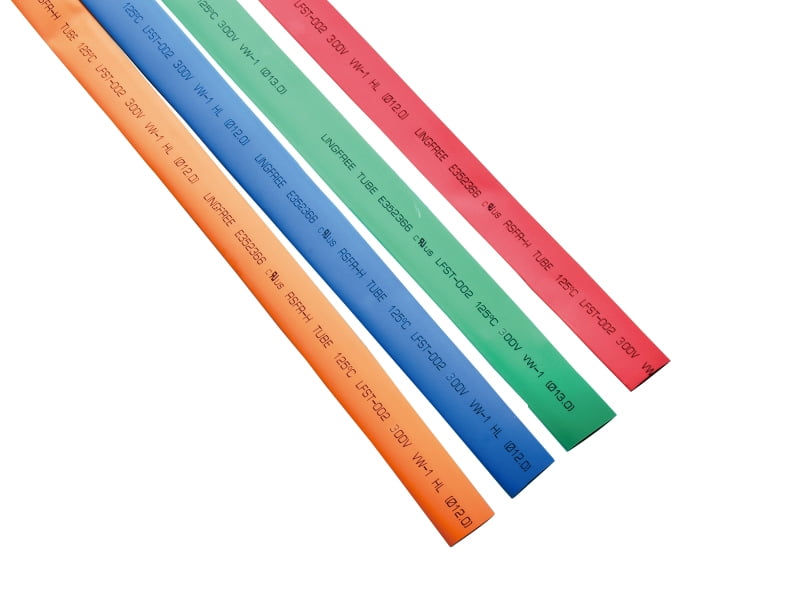
Quick Overview
The core difference comes down to wall thickness, and everything else — flexibility, mechanical strength, voltage rating — follows from that one variable.
Ultra Thin Heat Shrink Tube: wall thickness roughly 0.05mm–0.15mm, built for space-constrained, low-stress applications
Standard Heat Shrink Tube (e.g. UL Heat Shrinkable Sleeve): thicker wall build, built for general-purpose insulation where mechanical durability matters more than size
Wall Thickness and Shrink Ratio
Ultra thin tubing typically runs 0.05mm to 0.15mm in wall thickness, with shrink ratios of 2:1, 3:1, or 4:1. Standard tubing has a noticeably thicker wall — usually several times that — which gives it more material to resist punctures and abrasion, but also means it adds more bulk to the finished harness. If your components are already packed tightly (PCB assemblies, wearables, thin-gauge signal wires), that extra bulk from standard tubing can be the difference between a part that fits and one that doesn't.
Temperature and Voltage Rating
Both types typically operate across a similar temperature range, roughly -55°C to 125°C, so temperature alone usually isn't the deciding factor. Voltage rating is where the gap shows up: thin-wall tubing generally handles lower dielectric strength (in the range of 300V–600V), while standard-wall tubing, with more insulating material between the conductor and the outside world, supports higher voltage applications more comfortably.
If your application involves high-voltage busbars or power cables, thin-wall tubing is usually the wrong tool for the job regardless of how tight the space is — you'd want to look at heavier-wall or purpose-built New Energy Heat Shrinkable Tubing instead.
Mechanical Strength and Durability
This is the trade-off that catches people off guard. The thinner wall that makes ultra thin tubing so space-efficient also makes it more vulnerable to puncture, sharp edges, and repeated flexing. Standard tubing's thicker wall gives it more resistance to abrasion and mechanical stress over the life of the product, which matters in harnesses that get handled, bent, or exposed to vibration repeatedly — automotive engine bays and industrial equipment, for example.
When Ultra Thin Heat Shrink Tube Is the Right Choice
Compact electronics: smartphones, wearables, drones, laptops
PCB assemblies and microelectronics with fine-gauge wire
Medical devices where flexibility and a low profile matter
High-density wiring where every millimeter of harness diameter counts
When Standard Heat Shrink Tube Is the Right Choice
General automotive and industrial wiring exposed to abrasion or vibration
Cable joints and terminals that get handled during maintenance
Applications needing higher voltage insulation margin
Outdoor or harsh-environment runs where mechanical durability outweighs size savings
Not sure which wall thickness fits your harness? Send us your wire diameter, voltage, and installation environment and we'll confirm the right spec within 24 hours.
Which One Should You Choose?
Neither option is universally "better" — they're built for different constraints. If your bottleneck is physical space or weight, ultra thin tubing solves that at the cost of some mechanical margin. If your bottleneck is durability, voltage rating, or exposure to rough handling, standard tubing's thicker wall is the safer choice even though it takes up more room. When a single harness needs both — tight routing near a connector but higher stress elsewhere — it's common to spec both types in different sections of the same assembly rather than force one tube to do both jobs.
FAQ
1. Is ultra thin heat shrink tube weaker than standard tube?
In terms of puncture and abrasion resistance, yes — the thinner wall has less material to absorb mechanical stress. It's not weaker in insulation quality, just less durable against physical damage.
2. Can I use ultra thin tube for automotive wiring?
It depends on the location. It works well for signal wires and sensor connections in tight spaces, but engine bay harnesses exposed to vibration and abrasion are usually better served by standard-wall tubing.
3. Does standard tube cost more than ultra thin tube?
Material cost per meter is often comparable; the bigger cost factor is usually shrink ratio, certification requirements, and order volume rather than wall thickness alone. Send us your specs for an accurate quote.
4. Can both types meet UL flame retardant standards?
Yes, both ultra thin and standard Heat Shrink Tubing are available in UL 224 VW-1 compliant versions — flame retardancy depends on the material formulation, not wall thickness.
Whether you land on Ultra Thin Heat Shrink Tube or standard-wall tubing, matching the spec to your actual application conditions — not just what's cheapest or in stock — is what prevents rework down the line. Tell us your use case and we'll recommend the right fit.
