


 English

Choosing the wrong heat Shrink Tube for an EV or battery pack harness is not a small mistake. A tube rated for general electronics can crack under thermal cycling, fail a dielectric test, or fall short of the flame standards your customer's spec sheet requires. If you're sourcing insulation for new energy wiring, here's what to actually check before you place an order for a New Energy Heat Shrinkable Tube.
As a manufacturer that has supplied insulation tubing since 2008, we get this question from procurement teams and harness assemblers almost every week: "which spec do I actually need?" This guide breaks it down by the factors that matter for new energy applications specifically — not generic heat shrink advice.
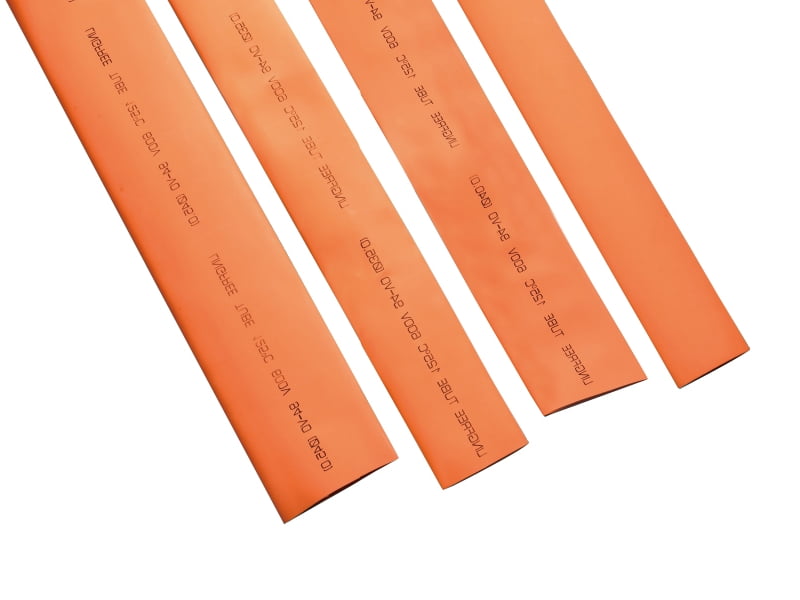
What to Look for When Choosing a New Energy Heat Shrinkable Tube
Before comparing suppliers or prices, narrow your decision down to five factors: material and temperature rating, shrinkage ratio, certification, chemical resistance, and supplier customization capability. Getting any one of these wrong usually means a rework or a failed inspection later.
Key Technical Specifications to Check
Start with the datasheet, not the marketing copy. For a genuine new energy grade tube, you want to confirm:
Material: polyolefin composite (not standard PVC or thin-wall PE)
Operating temperature range: -40°C to 125°C
Shrinkage temperature: 70°C to 125°C
Shrinkage ratio: 2:1 or 3:1, depending on how much oversize clearance your harness needs
Inner diameter range: from around 16mm up to 60mm for standard sizes, with custom sizing available for tighter or larger diameters
If your application involves unusually large busbars or very fine wiring, ask your supplier for custom ID ranges rather than forcing a standard size to fit — an oversized or undersized tube compromises the seal and the insulation margin.
Certification and Safety Standards to Verify
This is the step buyers skip most often, and it's the one that causes the most trouble during customer audits or import inspection.
UL certification with a valid file number — ask for it, don't take "UL-rated" at face value
ROHS compliance for restricted substances
REACH compliance for the EU market
Halogen-free composition, especially for enclosed EV cabins and battery housings where toxic gas release during a fire is a real safety concern
A supplier that can't produce a UL file number on request is a red flag, not a cost-saving opportunity.
Matching the Tube to Your Application Scenario
"New energy heat Shrink Tube" covers a range of use cases, and each one puts different stress on the material:
EV battery pack and motor wiring — needs high chemical resistance to battery acid, coolant, and oil, plus consistent shrink at moderate temperatures
High-voltage busbars and DC power cables — needs higher dielectric strength and thicker wall build for insulation margin at 600V and above
Charging station cable interfaces — needs abrasion resistance and UV stability if any part of the run is exposed outdoors
Solar and wind DC output cables — needs strong UV and weathering resistance for long-term outdoor exposure
If your application spans more than one of these — for example a battery pack harness that also routes through an outdoor junction box — tell your supplier both conditions upfront so they can recommend the right wall thickness and additive package instead of a compromise spec.
Tell us your target voltage, wire diameter, and installation environment, and we'll confirm the right shrink ratio and wall thickness for your New Energy Heat Shrinkable Tubing order within 24 hours.
Evaluating Supplier and Manufacturing Capability
Specs on paper only matter if the factory can actually deliver them consistently at volume. Before committing to a supplier, check:
Can they customize color, printing, and pre-cut lengths for your production line?
Do they hold consistent lot-to-lot quality, or does shrink performance vary between batches?
Can they support both prototype quantities and full production runs without a large minimum order jump?
Do they provide test reports or samples before a bulk order?
Cost Considerations Without Compromising Safety
A cheaper, uncertified tube might save a few cents per meter, but a single insulation failure in a battery pack or high-voltage harness costs far more in warranty claims, recalls, or safety incidents. Treat certification and material grade as non-negotiable, and negotiate on lead time, packaging, or order volume instead.
Why Choose Lingfree New Energy Heat Shrinkable Tube
Certified and Traceable
Our new energy tubing carries UL certification (File No. E352366), along with ROHS and REACH compliance, so your documentation is ready for customer audits.
Built for Harsh Operating Conditions
Rated for -40°C to 125°C operation with strong chemical and corrosion resistance, suitable for battery packs, EV harnesses, and outdoor renewable energy installations.
Flexible Sizing and Customization
Standard ID range from 16mm to 60mm in 2:1 and 3:1 shrink ratios, with custom sizes, colors, and print options available for OEM production lines.
Choosing the right New Energy Heat Shrinkable Tube comes down to matching real technical requirements — temperature, voltage, chemical exposure, and certification — to your specific application, rather than picking whatever is cheapest on a spec sheet. If you're not sure which spec fits your harness, send us your application details and we'll recommend the right configuration.
FAQ
1. What shrink ratio should I choose, 2:1 or 3:1?
Use 2:1 for tighter clearance over connectors or terminals; use 3:1 when you need to cover irregular shapes or a wider range of wire diameters with one size.
2. Is UL certification required for EV applications?
It's not always legally mandatory, but most EV OEMs and Tier 1 suppliers require it as part of their quality documentation, so it's strongly recommended.
3. Can the standard orange color be changed?
Yes, custom colors and printing are available for OEM orders — just specify this when requesting a quote.
4. What's the minimum order for custom sizes?
This depends on the specific dimension and material — send us your requirements and we'll confirm MOQ along with the quote.
